Wandering the boardwalks will take you by our small lake.
You will also come to the Team Tuatara pen where
you may spot, if you look carefully, juvenile tuatara
basking in the sun. Bird-feeding stations are dotted
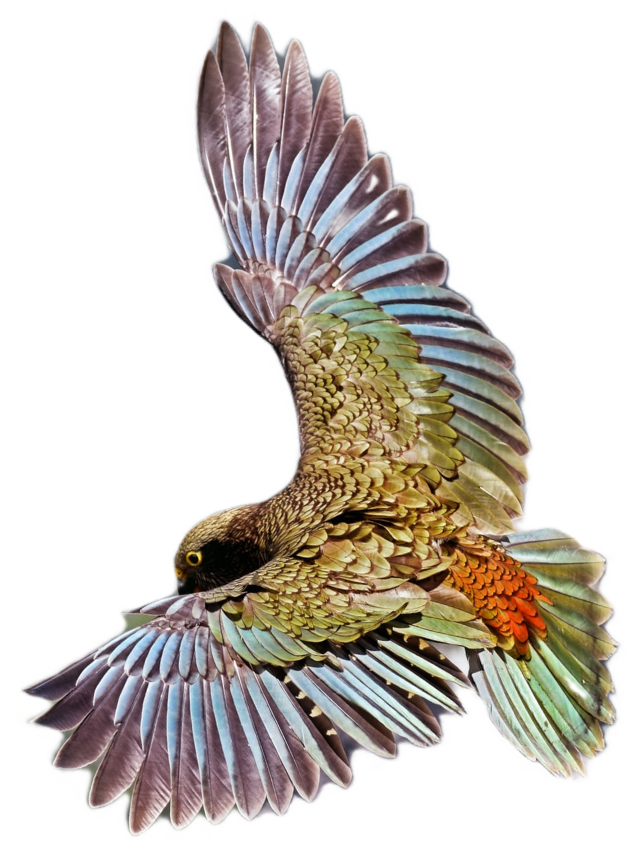
alongside the boardwalk. Look for kākāriki, tui,
korimako (bellbird), hihi (stitchbird), tititi pounamu (rifleman),
pīwakawaka (fantail). Don't forget to check the ground.
Takahē are wandering and if you look closely, you may see
prod marks in the ground from kiwi beaks.
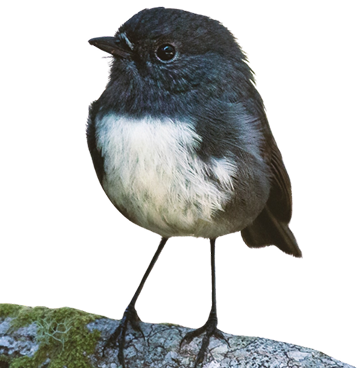
South Island robin adult males have a dark gray-black head and upper body, brownish-black feathers and tail and a white to yellowish-white lower breast and belly; adult females have a light to dark grey upper body and a smaller, less distinctly breast-belly area.
The South Island robin occurs in forest and scrub habitats, where it spends much time foraging on the ground, and can be recognised by its erect stance and relatively long legs. It is a territorial species, males in particular inhabiting the same patch of forest throughout their lives. Males are great songsters, particularly bachelors, singing loudly and often for many minutes at a time. Where robins are regularly exposed to people, such as along public walking tracks, they become quite confiding, often approaching to within a metre of a person sitting quietly. Juveniles will sometimes stand on a person’s boot.
The South Island robin, also known as kakaruwai, is known for its friendly and curious nature, often approaching humans and even hopping onto their boots while foraging for food.
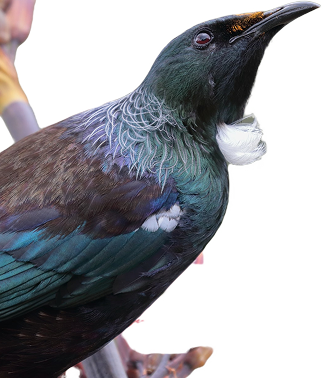
A large dark honeyeater with a decurved black bill, dark brown eyes, black legs and feet, and black head, underparts, wings and tail showing iridescent blue-green on the head and wings. The upper back and flanks are brown with a bronze sheen, the nape and sides of the neck have filamentous white feathers, and there are two curled white feather tufts on the throat.
Tūī are boisterous, medium-sized, common and widespread bird of forest and suburbia – unless you live in Canterbury. They look black from a distance, but in good light tūī have a blue, green and bronze iridescent sheen, and distinctive white throat tufts (poi). They are usually very vocal, with a complicated mix of tuneful notes interspersed with coughs, grunts and wheezes. In flight, their bodies slant with the head higher than the tail, and their noisy whirring flight is interspersed with short glides.
Tanemahuta, the father of the forest noticed that his children, the trees were sickening, as they were being eaten by bugs. He spoke to his brother Tanehokahoka who called to his children, the birds, to come together. Tanemahuta told the birds that his children were dying and that he needed one of them to come from the forest roof to live on the forest floor. Tūī shuddered when he looked down and saw the cold, dark forest floor. Tūī preferred the forest roof and the filtering sun through the leaves. He was afraid of the dark. Tūī said no to Tanemahuta. Kiwi was the brave bird that said yes. Tūī are very recognizable with their distinctive white tuft under their throat.

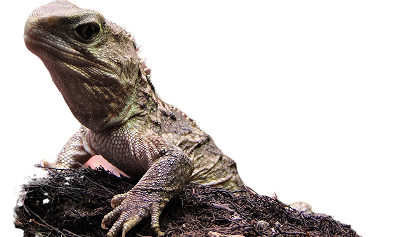
Tuatara can be identified by their unique features, including a spiny crest along their back, a lack of external ears, and a distinctive arrangement of teeth with two rows on the upper jaw. They are typically greenish-brown in color and can grow up to 80 cm (31 inches) long.
Mostly nocturnal, the tuatara - like lizards - will bask on rocks in the sun during the day. They are very slow growing, take 2 to 5 years for each reproduction cycle, and live for a very long time.
Tuatara can live for over 100 years, making them one of the longest-living reptiles in the world. They are also unique because they have a "third eye" on the top of their head, which is sensitive to light but not used for seeing.
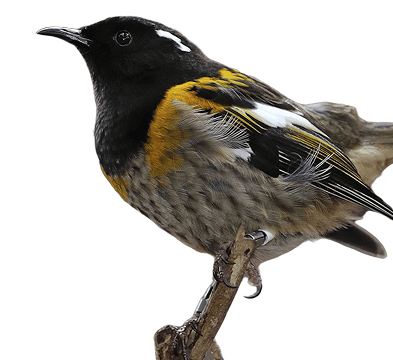
A bird with a slender down-curved blackish bill, bold white wing-bars and a habit of cocking its tail. Males have a black head with white ear tufts, yellow neck and shoulder band, white wing-bars and greyish-brown body; females are greyish-brown apart from white wing bars and juveniles resemble adult females.
The hihi (stitchbird) was both rare and poorly known until the 1990s, as few people had an opportunity to visit the single remnant population on Little Barrier Island. However, thanks to successful conservation management and research, the hihi is now one of the better studied New Zealand bird species, and can be seen at several accessible translocation sites. Hihi are often curious, approaching people for close examination whilst emitting warning calls; yet the calls’ high pitch, and the bird’s rapid movements and colouration can make them hard to detect.
Hihi means ‘rays of the sun’. In reference to the bird, hihi refers to the male’s yellow breast plumage which looks like the colour of sun and fire. Māui the demigod, threw Hihi into the fire after Hihi had refused to bring water to Māui. Hihi’s feathers were burnt.
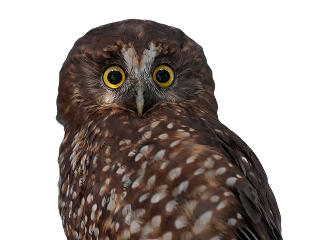
A small, dark brown owl of forests and forest remnants, including in suburbs. Most often detected by its characteristic 'morepork' or 'ruru' call, ruru have a range of other calls often confused with kiwi ('cree') and little owl ('yelp').
The ruru (or morepork) is a small, dark, forest-dwelling owl. Found in both native and plantation forests, its distinctive “more-pork” call is commonly heard at night in many urban parks and well-vegetated suburbs. Ruru are relatively common throughout much of New Zealand but are sparse through the eastern and central South Island. Their diet consists of insects, small mammals and birds, which it hunts at night.
The ruru (also called the morepork) is New Zealand’s only surviving native owl and it gets its name from the haunting “ruru… ruru…” sound of its call. In Māori tradition, the ruru is often seen as a kaitiaki (guardian) and a messenger between the living and the spirit world.